GTA 6 Map Analysis: Leonida Scale, Vice City Districts & Full GTA 5 Comparison
How large is the state of Leonida compared to GTA 5's Los Santos? Here is the definitive breakdown of confirmed cities, counties, entering interior buildings, and how Rockstar's modular world map will evolve post-launch.

Mapping Leonida: The Scale, Geography, and Architectural Evolution of GTA 6
When Rockstar Games released the debut trailer for Grand Theft Auto VI, it shattered viewership records within hours. Yet beyond the cinematic introductions of protagonists Lucia and Jason, the true protagonist of the showcase was the sun-drenched, chaotic environment: the state of Leonida.
Ever since the historic 2022 development leak, community mapping projects comprising hundreds of data analysts and cartographers have meticulously reverse-engineered in-game coordinate data, elevation vectors, and road signs. What this collaborative telemetry proves is clear: GTA 6 does not simply offer an updated Vice City. It introduces an expansive state that dwarfs any open-world environment Rockstar has ever compiled.
Below is an exhaustive geographical breakdown of confirmed cities and biomes, a mathematical scale comparison against GTA 5's Los Santos, and an engineering look at how the map is built to expand over time.
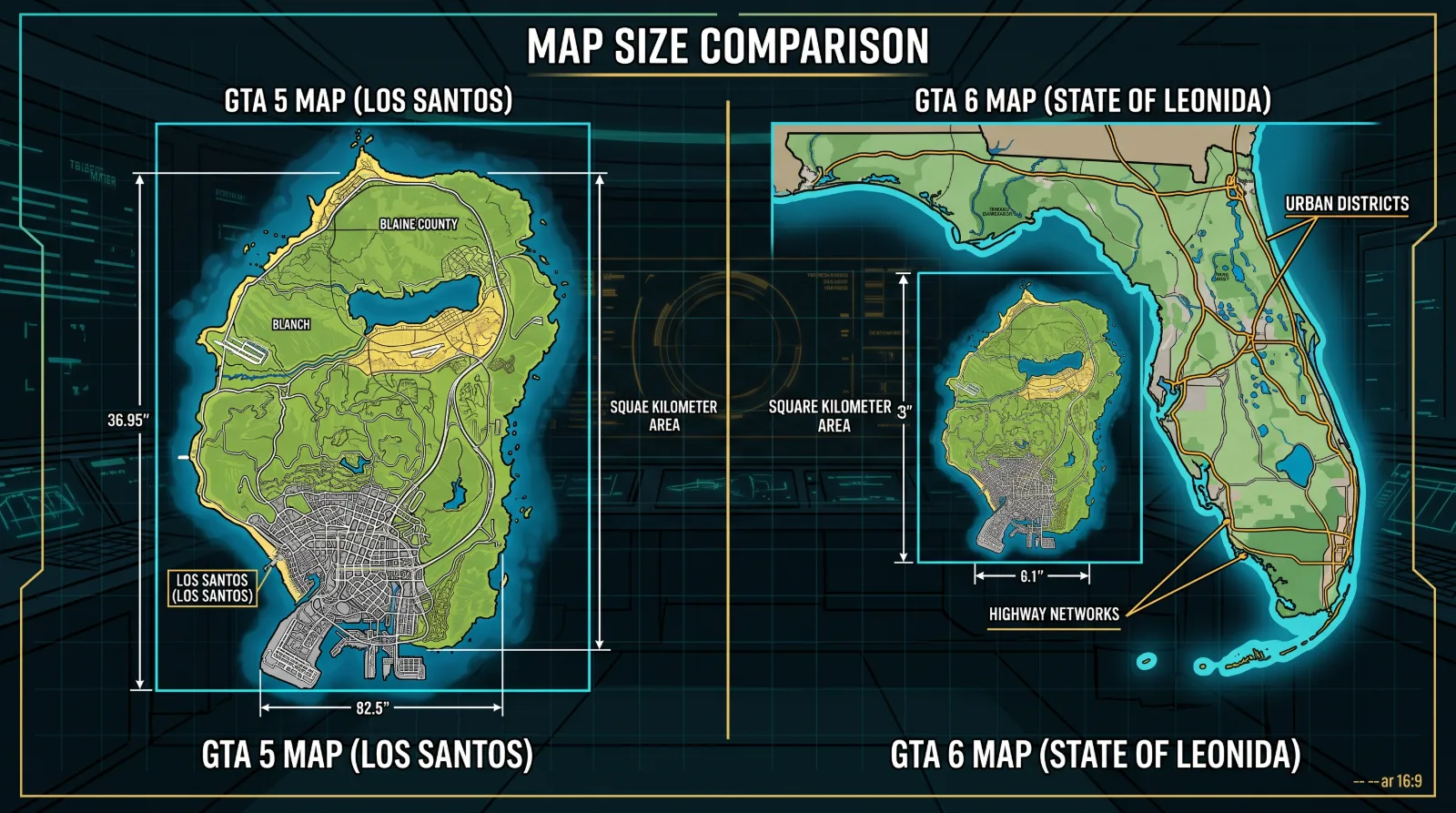
Confirmed Counties, Cities, and Regions
Leonida is modeled on the geographic and cultural diversity of modern Florida, spanning dense metropolitan hubs, industrial shipping corridors, agricultural flatlands, and treacherous wetlands:
- Vice City Metro (Vice City & Kelly County): The beating heart of the map, modeled after Miami-Dade. Features glamorous beachfront avenues along Ocean Beach, the art-deco commercial district, luxury residential islands (Starfish Island equivalents), and dense Latin neighborhoods modeled on Little Havana.
- Port Gellhorn & The Industrial West: Situated across the western coastline, Port Gellhorn represents modern industrial Florida: commercial freight ports, decaying motel strips, petroleum storage hubs, and a large correctional institution where Lucia’s narrative begins.
- The Grassrivers & Ambrosia (The Florida Everglades): An immense wetland biome crisscrossed by shallow riverbeds, sawgrass flats, and mangrove trees. Navigating this region demands specialized airboats and off-road vehicles, with wildlife hazards including massive alligators and wild boars.
- The Keys (Gellhorn Keys & South Archipelago): A sweeping chain of tropical coral barrier islands linked by long overseas highway viaducts, ending in isolated fishing villages and luxury marina docks.
- Mount Chiliad Replacement & Rural North: Unlike the real Florida flatlands, internal telemetry indicates rolling northern elevations with dense pine forests, mining quarries, and rural small-town trailer parks designed for high-speed highway chases.
Scale Comparison: How Much Larger Is Leonida Than GTA 5?
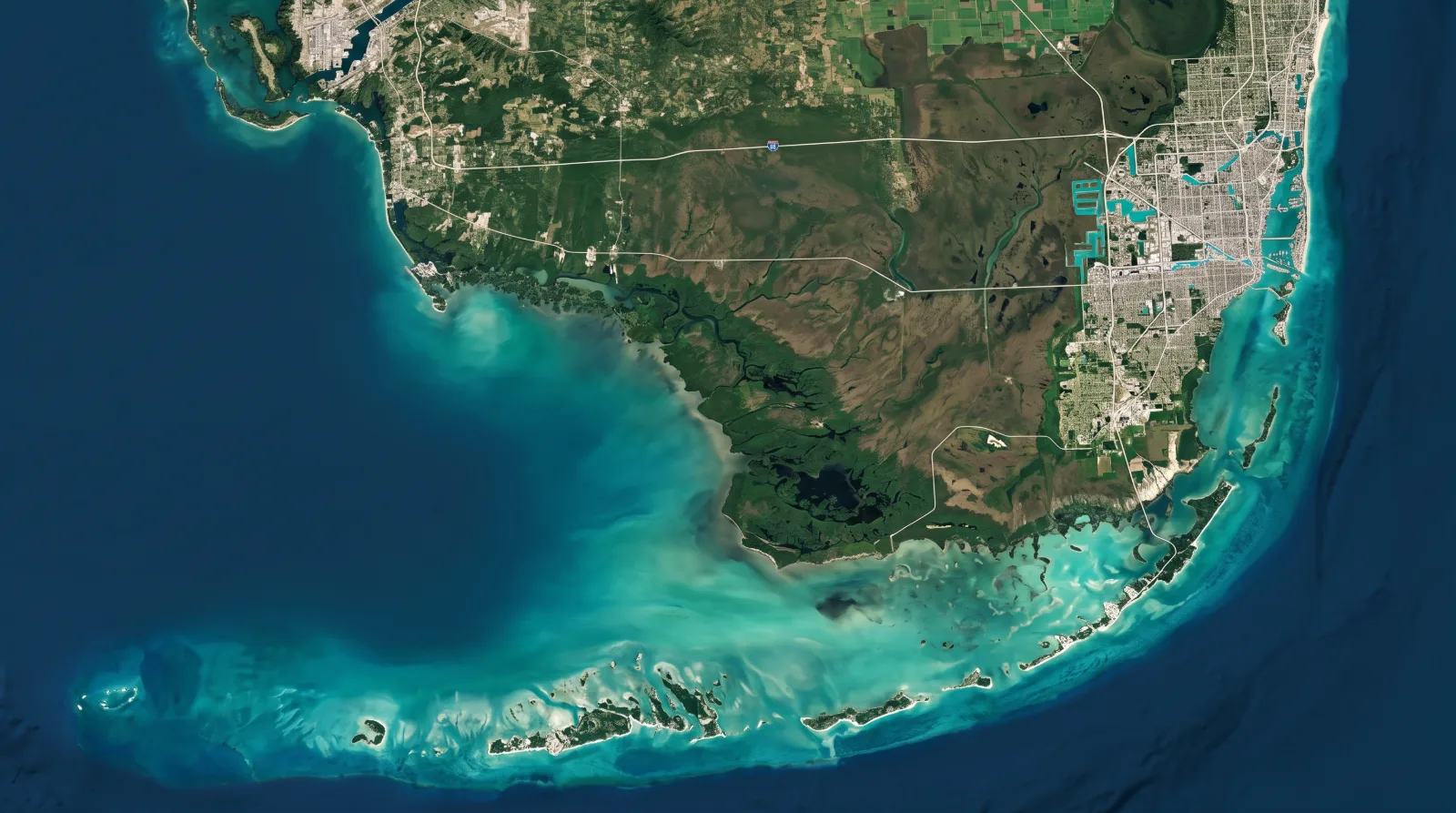
To evaluate the physical landmass of GTA 6, cartographers cross-referenced RAGE engine coordinate units extracted from public development footage:
| Geographic Metric | GTA 5 (San Andreas / Los Santos) | GTA 6 (The State of Leonida) | Generational Scale Delta |
|---|---|---|---|
| Total Land Area | Approximately 75.84 square kilometers | Estimated 185 to 210 square kilometers | Approximately 2.5x to 2.8x larger |
| Metropolitan Footprint | Los Santos urban core only | Multi-city framework (Vice City, Port Gellhorn, Hamlet) | More than double the urban square footage |
| Water & Ocean Depth | Vast empty perimeter boundaries | Traversible shallow bays, coral reefs, and navigable inland marshes | Active fluid simulation and boat trafficking |
| Accessible Interiors | Sub-5% of total world buildings | Estimated 40% to 50% interior access | Unprecedented interior density |
The key takeaway is density over empty space. While large portions of GTA 5 consisted of impassable arid mountain ridges (Mount Josiah, the Paleto mountains), Leonida features active functional infrastructure across almost every quadrant.
The Interior Revolution: Unlocking 50% of the World
The most significant architectural leap in GTA 6 is not horizontal ground space; it is vertical and interior accessibility.
In previous entries, over 95% of city skyscrapers were hollow geometric boxes with textured windows. Development documentation confirms that Rockstar prioritized building access:
- Fully Rendered Commercial Chains: Players can walk seamlessly into gas station mini-markets, pawn shops, diners, 24-hour laundromats, and gun shops without loading transitions.
- High-Rise Hotel & Apartment Corridors: Residential towers feature interactive elevator mechanics, furnished hotel suites, and rooftop lounges with functional glass barriers.
- Dynamic Robbery Locations: Small-scale businesses feature working cash registers, employee break rooms, and accessible surveillance systems that tie directly into Lucia and Jason's early-game petty robbery loops.
How the Map Will Evolve Post-Launch (Project Americas Architecture)
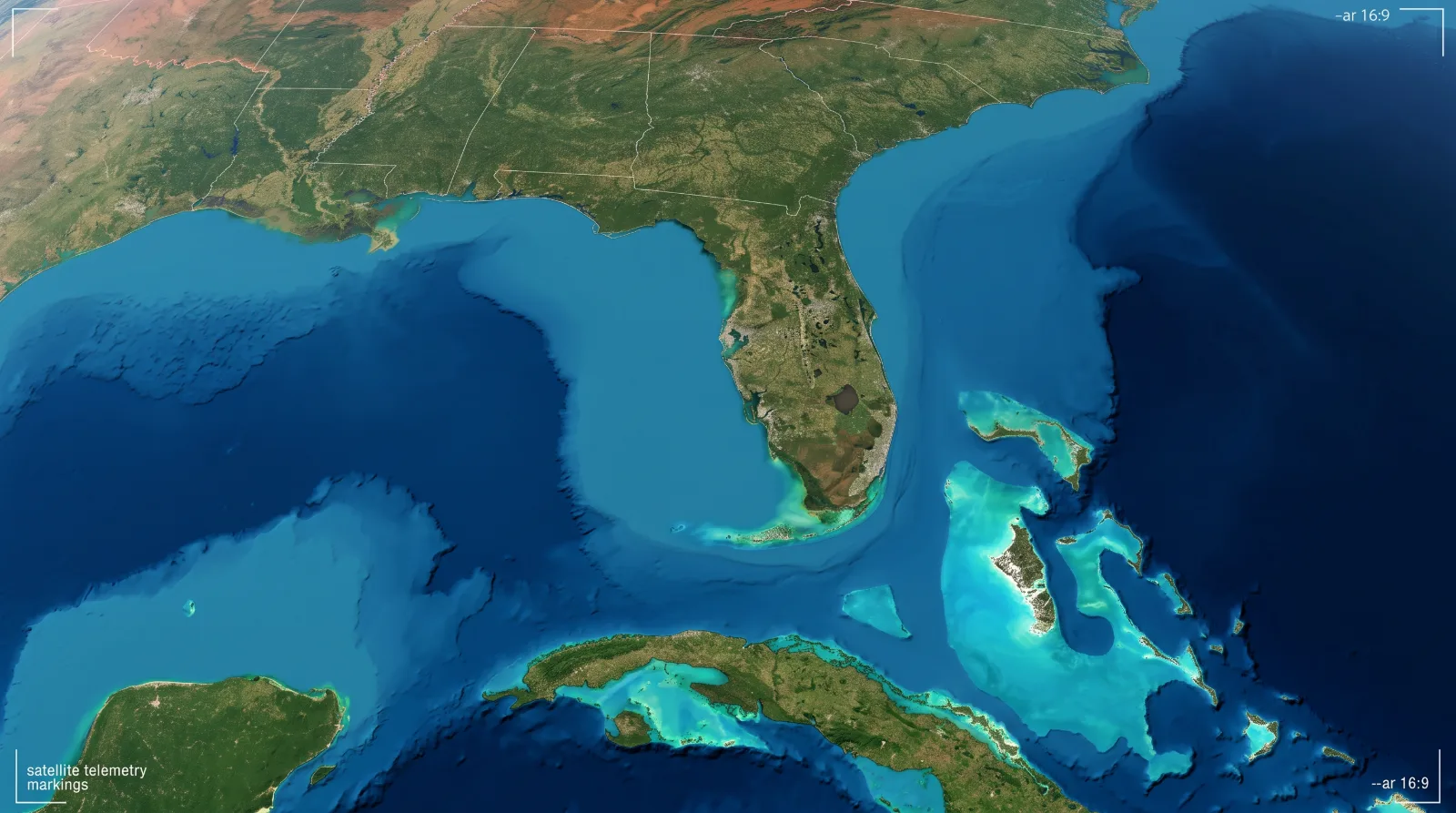
When initial development began under the codename Project Americas, Rockstar’s original ambition was to feature both North and South American landmasses. While leadership scaled back the scope to focus on a hyper-dense recreation of Florida for launch, the engine architecture retains modular expansion capabilities:
Modular Map Evolution Blueprint:
Launch Phase: Complete state of Leonida with primary metropolitan Vice City and surrounding counties.
Post-Launch Expansions: The southern oceanic expanse is deliberately calibrated to accommodate offshore islands. Future GTA Online updates and narrative expansions can introduce Caribbean archipelago islands, private cartel paradises, and Central American smuggling airstrips without altering mainland road geometry.
Dynamic World Events: Real-time environmental destruction, active construction skyscraper completions, and seasonal hurricane storm surges that temporarily flood low-lying coastal neighborhoods.
Technical Execution: Zero-Loading Asset Streaming
Powering a landmass of this scale with dense crowd AI and dynamic weather simulation is only possible on modern solid-state drive pipelines:
- Eliminating Legacy Bottlenecks: Dropping older console generations allows the RAGE engine to stream high-resolution 4K street textures at extreme vehicle speeds without pop-in.