Swoop Card Game: Rules, Tips, and Tricks for Beginners
Learn how to play the fast-paced Swoop card game with our easy step-by-step instructions, card rank cheat sheets, and strategies.
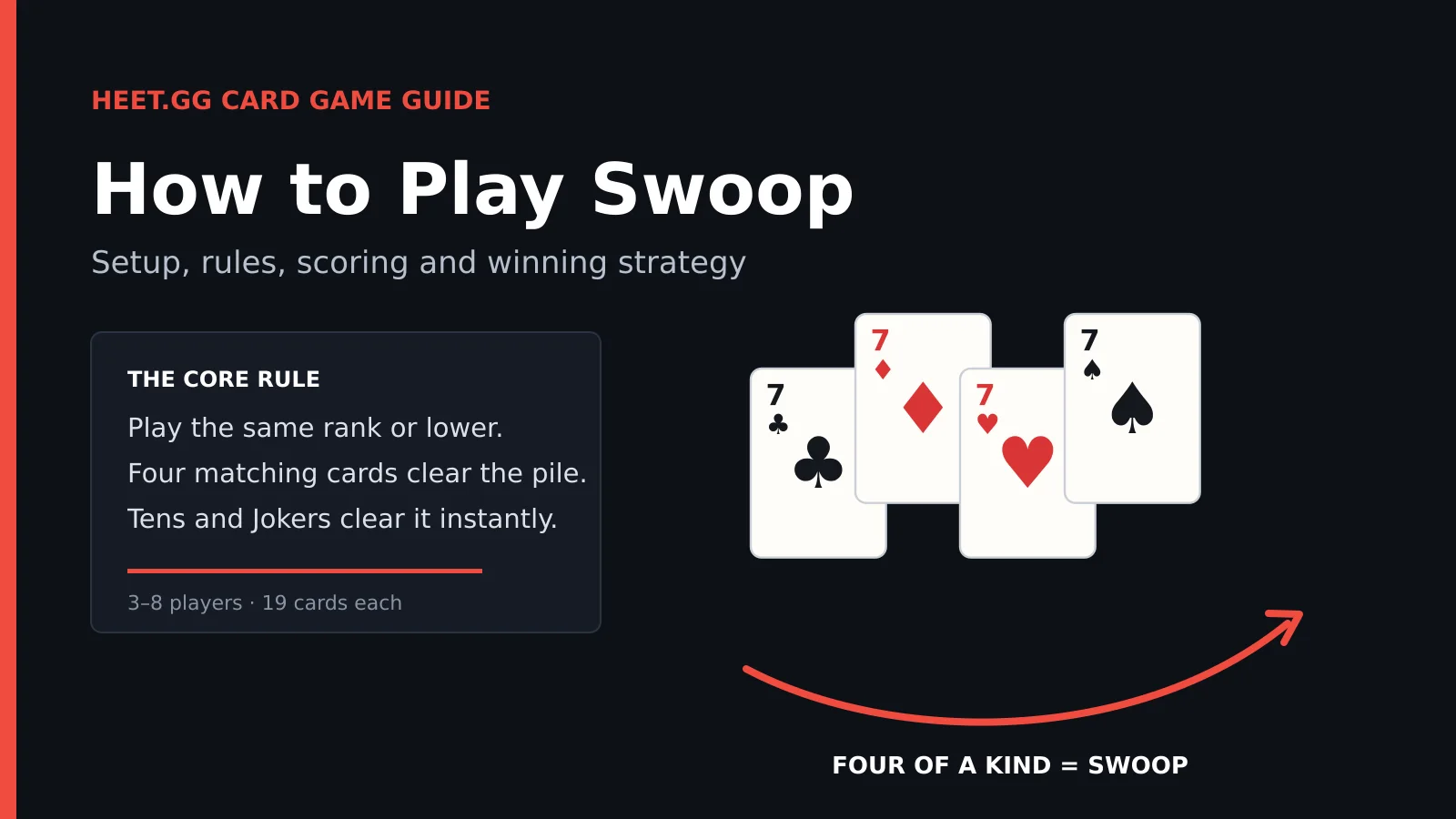
How to Play Swoop: Complete Card Game Rules
Swoop is a competitive card-shedding game in which players try to get rid of 19 cards spread across their hand, face-up board cards and hidden mystery cards.
To play, place one or more matching cards on the center pile. Your cards must normally be equal to or lower than the previous rank. Complete a group of four matching cards, play a 10 or use a Joker to perform a Swoop, clearing the entire pile and earning another turn.
The first player to discard every card wins the round. Everyone else scores penalty points for the cards they still hold, so a well-timed Swoop can completely change the result.
Quick rule: Play the same rank or lower. If you play higher, you must pick up the existing center pile. Four matching cards, a 10 or a Joker clears the pile.
What Is Swoop?
Swoop is a shedding and accumulation card game for approximately three to eight players. It is sometimes also called Swipe, Swoosh or Swish.
The game shares a few ideas with games such as Palace and Shithead: players have cards in their hand and on the table, special cards clear the center pile, and an unsuccessful play can force someone to pick up a large stack.
However, Swoop has its own identity. Every player begins with 19 cards, multiple standard decks are combined, and each round contributes to a cumulative score.
Swoop is not normally a speed or reflex game. Players take turns clockwise, and nobody needs to race to grab cards. Suits also have no effect: only a card’s rank matters.
What You Need to Play Swoop
For the standard playing-card version, use regular 52-card decks with two Jokers in each deck.
Players Decks required Total cards
3–4 2 decks 108
5–6 3 decks 162
7–8 4 decks 216
Each player receives 19 cards. Because of that unusually large deal, one deck is not enough for a normal multiplayer game.
Card suits are ignored. The ordinary cards rank from low to high:
Ace, 2, 3, 4, 5, 6, 7, 8, 9, Jack, Queen, King
Tens and Jokers are special Swoop cards rather than normal ranked cards.
Commercial Swoop sets may replace standard playing cards with numbered cards and dedicated Swoop cards. Follow the included manual when using one of those sets, since its scoring system may differ slightly.
Looking for something that works with fewer cards? HEET’s guide to three-player card games includes several easier alternatives.
How to Set Up Swoop
Give every player 19 cards and divide them as follows:
Place four cards face down in a row without looking at them. These are your mystery cards.
Place one face-up card on top of each mystery card.
Pick up the remaining 11 cards as your private hand.
Put all undealt cards aside. They are not used during that round.
Choose a starting player. Play then moves clockwise.
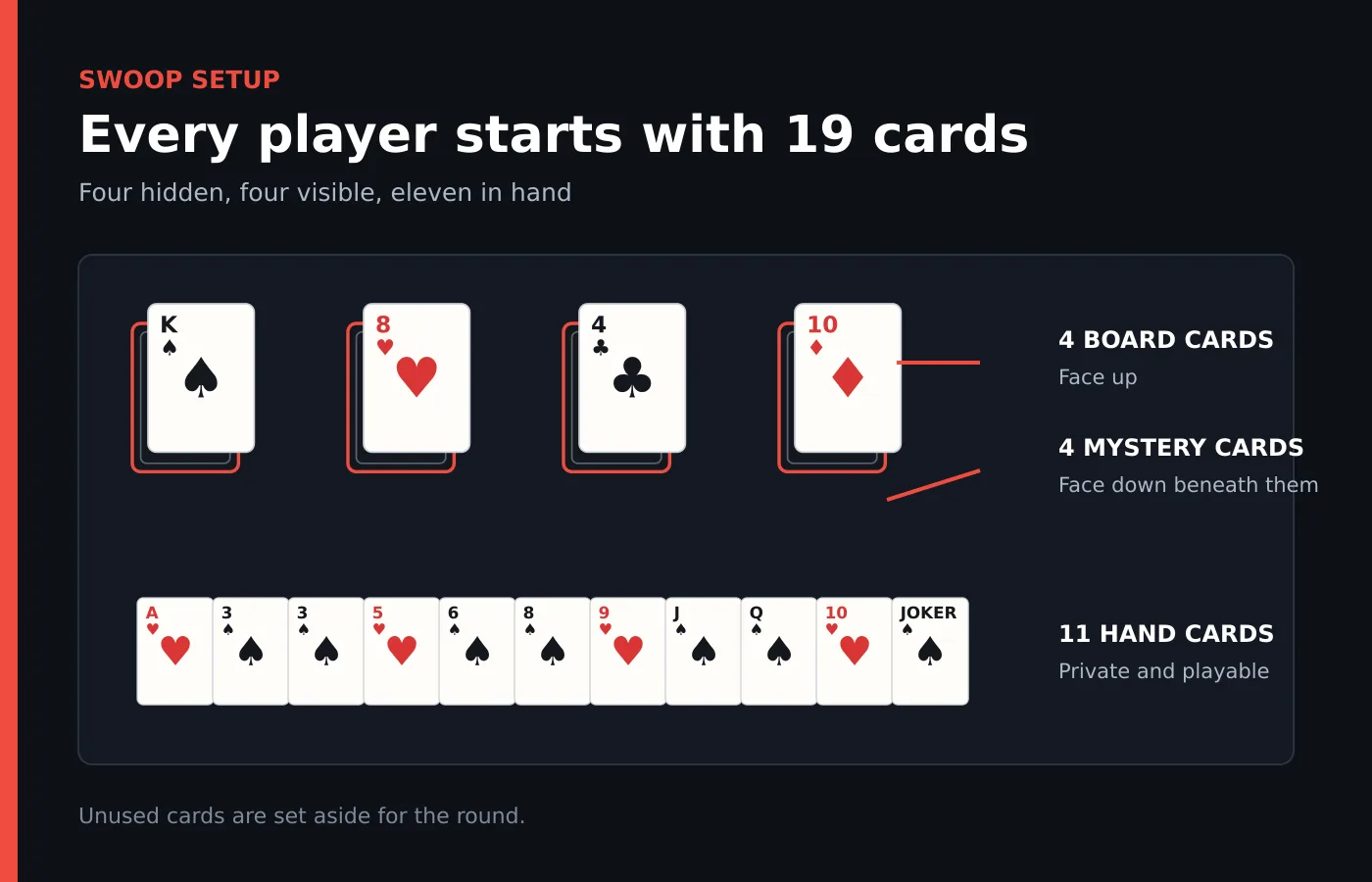
Players may sort the 11 cards in their hand by rank. This makes matching sets and potential Swoops easier to spot.
For the first round, choose the starting player randomly or let everyone draw from the unused cards, with the highest rank going first. Move the starting position clockwise after every round.
How to Play Swoop
- Start the center pile
The starting player places one to four cards of the same rank in the center.
These cards can come from:
The player’s hand
Their face-up board cards
A combination of both locations
If multiple cards are played together, they must all have the same rank. You cannot play a mixed run such as 7-6-5.
- Play an equal or lower rank
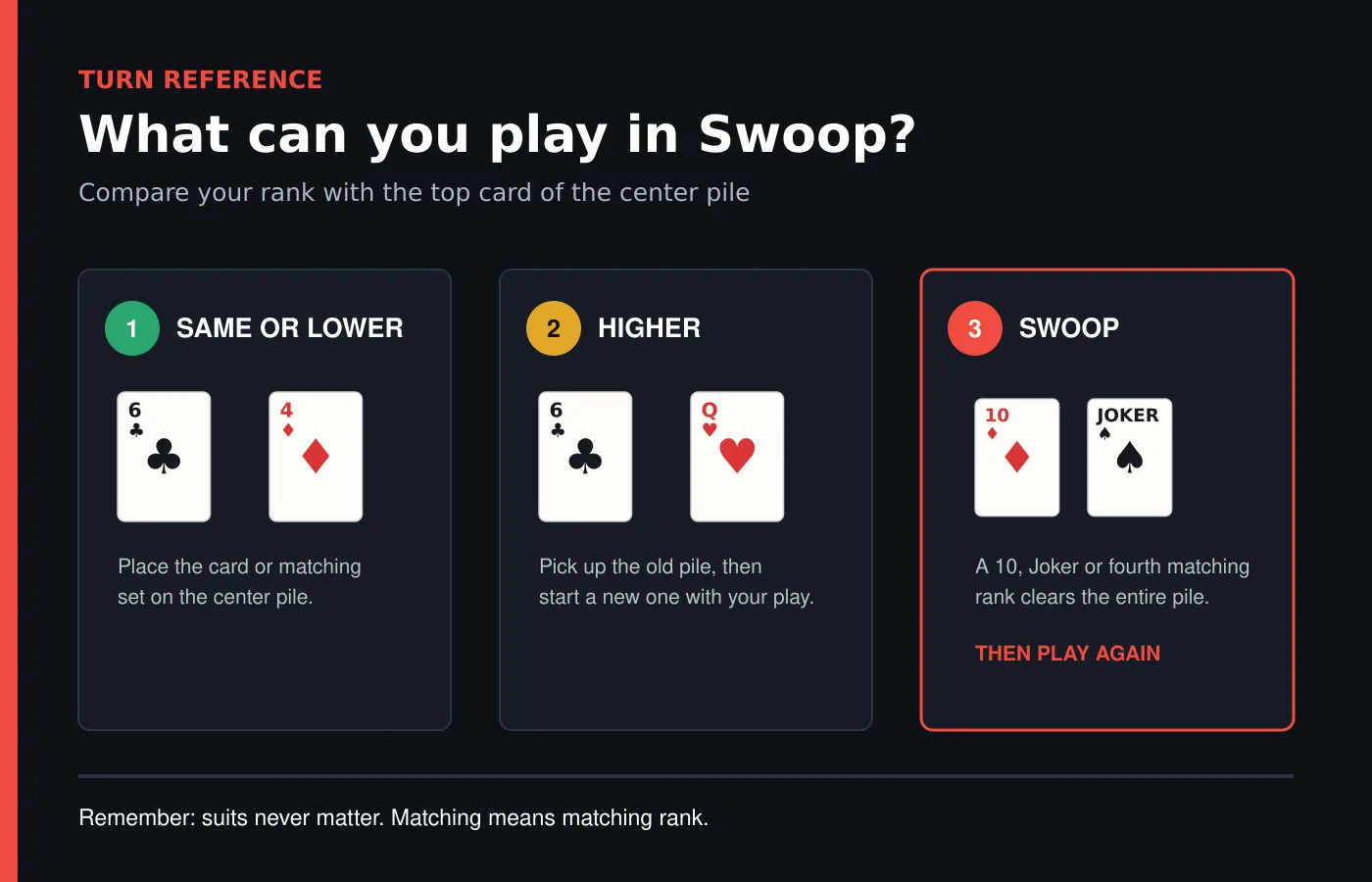
The next player places one or more matching cards that are equal to or lower than the rank currently on top of the center pile.
For example, if the top card is an 8, you can play:
One or more 8s
One or more 7s
One or more cards of any lower rank
A 10 or Joker to clear the pile
Suits do not need to match.
- Pick up the pile when playing higher
You are not simply eliminated from the turn if your cards are too high.
If you play a rank higher than the current top card, you must first pick up the entire center pile and add those cards to your hand. Your higher card or matching set then becomes the beginning of a new center pile.
For example, if the center pile ends in a 6 and you play a Queen:
Pick up the existing pile.
Add it to your hand.
Place the Queen down as the first card of a new pile.
End your turn unless that play caused a Swoop.
Picking up the pile can turn a nearly empty hand into a difficult comeback, which is why controlling the rank is so important.
How a Swoop Works
A Swoop removes the entire center pile from the round.
You perform one when:
The top four cards are all the same rank
You play a 10
You play a Joker
The four matching cards do not have to be placed by one person. Consecutive players can build the group.
For example:
One player places two 5s.
The next player adds one 5.
You play the fourth 5.
You perform the Swoop and remove the complete center pile.
The player who completes the Swoop immediately takes another turn and starts a new pile with any legal card or matching set.
You can perform several Swoops during the same turn if your cards allow it.
Can you play more than four matching cards?
Under the standard rule, the visible run should not exceed four cards of the same rank.
If three 8s are already on top of the pile and you hold two more 8s, play only one to complete the Swoop. After clearing the pile, you can use your bonus turn to play the remaining 8.
Some groups allow four or more matching cards instead. Agree on this house rule before starting.
Special Cards
Tens
A 10 can be played regardless of the current rank. It immediately clears the center pile and gives you another turn.
Tens are powerful, but they are also worth 50 penalty points in the standard scoring system. Holding one for too long can be expensive.
Jokers
A Joker works like a 10:
It can be played on any rank.
It clears the center pile.
The player receives another turn.
It is worth 50 penalty points if left over when the round ends.
The safest strategy is usually to keep a Joker for a dangerous pile without waiting so long that another player goes out first.
How Mystery Cards Work
Each face-down mystery card begins the round covered by a face-up board card.
You cannot use a mystery card until the face-up card above it has been played. Once uncovered, a mystery card may be revealed only at the beginning of one of your turns, including a bonus turn earned from a Swoop.
When you choose a mystery card:
Turn it face up.
Play it immediately.
Add any matching cards from your hand or board if desired.
Resolve the play normally.
You cannot inspect the card and return it face down.
If the mystery card is equal to or lower than the center card, it is played normally. If it is higher, you must pick up the center pile. If it is a 10 or Joker, it immediately causes a Swoop.
This hidden final stage keeps the outcome uncertain even when one player appears close to winning.
How to Win a Round
You go out when you have no cards remaining in:
Your hand
Your face-up board row
Your mystery-card row
The round ends immediately when one player gets rid of their final card.
Unlike some shedding games, clearing only your hand is not enough. All eight table cards must also be played.
For another traditional tabletop game with a different type of tactical race, see HEET’s complete Wahoo rules and strategy guide.
Swoop Scoring
The player who goes out scores zero points. Everyone else counts the cards they still have in their hand and on the table.
Card Penalty value
Ace 1 point
2–9 Face value
Jack, Queen or King 10 points
10 50 points
Joker 50 points
Add these points to each player’s running total.
Continue playing rounds until at least one player reaches 500 points. At that moment, the player with the lowest cumulative score wins the complete game.
This means reaching 500 is not the goal. It triggers the end of the game, and high totals are bad.
Quick scoring example
Suppose a player has the following cards left when another player goes out:
One Ace
One 6
One Queen
One 10
One Joker
Their score is:
1 + 6 + 10 + 50 + 50 = 117 penalty points
That example shows why getting rid of Tens and Jokers before the end of a round matters.
Example of a Swoop Turn
Imagine the top of the center pile shows two 7s.
You hold:
Two 7s
One 4
One King
One Joker
Your strongest sequence is:
Play the two 7s to complete four consecutive 7s.
Clear the entire center pile.
Use your bonus turn to play the King onto the empty pile.
End your turn and keep the Joker as emergency protection.
Alternatively, you could play the Joker after clearing the sevens, create a second Swoop and then use another bonus turn to play the King or 4.
The second option removes more cards immediately, but retaining the Joker may be safer if another player is close to going out.
Seven Swoop Strategy Tips
- Play high ordinary cards early
Kings and Queens become difficult to play after the center pile drops to a low rank. Use them when the pile is empty or still high.
- Do not hoard every special card
Tens and Jokers are excellent rescue cards, but each can cost 50 points. Keep one when necessary, not an entire collection.
- Watch exposed board cards
Unlike private hands, board cards are public information. If an opponent has a visible King, forcing the pile down to a 2 or 3 makes that King dangerous.
- Count matching ranks
If three cards of one rank are showing consecutively, the next matching card completes a Swoop. Avoid feeding that opportunity to an opponent unless it improves your own position.
- Use a Swoop to unlock mystery cards
A Swoop gives you another turn. If one of your mystery cards is uncovered, that bonus turn is a valuable opportunity to reveal it while the center is empty.
- Split matching cards when useful
Playing every matching card at once empties your hand faster, but keeping one can help you complete a later Swoop. The correct choice depends on opponents’ visible cards and remaining card counts.
- Plan around penalty points
When another player has only one or two cards remaining, prioritize discarding Tens, Jokers and face cards. Preventing a large scoring loss can be more valuable than building the perfect combination.
Common Swoop Rule Mistakes
Matching by suit
Suits do not matter in the standard game. Players compare ranks only.
Playing higher without taking the pile
A higher ordinary card does not beat the previous card for free. You must pick up the old pile before starting the new one.
Flipping covered mystery cards
A mystery card cannot be revealed until its face-up covering card has been played.
Forgetting the extra turn
The player who causes a Swoop plays again immediately.
Treating the game as a race to grab cards
Players take orderly clockwise turns. There is no standard rule requiring everyone to race for the center pile.
Trying to reach 500 points
Points are penalties. When someone reaches the agreed limit, the lowest total wins.
Popular House Rules
Swoop has circulated informally, so many families use slightly different rules. Common variations include:
Dealing 20 cards instead of 19
Allowing more than four matching cards in a Swoop
Making only Jokers automatic Swoop cards
Giving Tens a normal rank
Using simplified penalty values
Ending after every player has started one round
Setting a lower target score for a shorter game
Write down your chosen rules before the first round. Most disagreements occur when players unknowingly learned different versions.
Swoop Card Game FAQ
Can you play Swoop with one deck?
Not under the normal 19-card setup for three or more players. Three players already require 57 dealt cards, so at least two decks are necessary.
How many cards does each player get?
Every player receives 19 cards: four mystery cards, four face-up board cards and 11 hand cards.
Do suits matter in Swoop?
No. Hearts, diamonds, clubs and spades have no gameplay effect. Only card rank matters.
Can you play multiple cards at once?
Yes. You may play one to four cards together when they all have the same rank.
What happens if you cannot play a lower card?
Play a higher card, pick up the existing center pile and use your played card to start a new pile. A 10 or Joker can clear the pile instead.
What cards automatically cause a Swoop?
In the standard playing-card version, a 10 or Joker automatically clears the pile. Completing four matching cards also causes a Swoop.
Do you get another turn after a Swoop?
Yes. The player who clears the pile immediately plays again.
Can you play a mystery card whenever you want?
Only after the face-up card covering it has been removed, and only at the beginning of your turn or a bonus turn. Once revealed, it must be played.
Is Swoop the same as Skip-Bo?
No. Both are shedding games, but their setup and rules are different. Skip-Bo uses ascending shared building piles, while Swoop uses a single center pile with equal-or-lower plays and pile-clearing combinations.
Is Swoop suitable for children?
The commercial version is marketed for ages seven and older. Younger players may need help remembering when to pick up the pile and how penalty scoring works.
Final Verdict
Swoop is easy to begin once everyone remembers three rules:
Play the same rank or lower.
Playing higher means taking the center pile.
Four matching cards, a 10 or a Joker clears the pile and gives you another turn.
The mystery cards add luck, but visible board cards, rank tracking and special-card timing give players meaningful tactical decisions. That balance makes Swoop particularly well suited to family game nights and larger groups.