From Loot Boxes to Battle Passes: The Psychology of Video Game Rewards
Why does opening a digital crate feel so thrilling? Here is an analysis of B.F. Skinner’s variable ratio schedules, audio-visual feedback loops, and how the industry transitioned from loot boxes into battle passes.

Engineering Compulsion: How Behavioral Psychology Shapes Modern Game Rewards
Modern video game development is no longer just an artistic endeavor; it is a discipline grounded in behavioral economics and neurochemistry. Game designers utilize sophisticated feedback systems to transform simple mechanical inputs into rewarding psychological experiences.
From the spinning animations of cosmetic loot crates to the multi-tiered unlock tracks of seasonal battle passes, monetization models rely on established principles of cognitive reinforcement.
Below is an examination of how reward mechanisms trigger behavioral retention, how audiovisual cues amplify perceived value, and why the global gaming industry shifted its economic foundation from random chance to linear engagement tracks.
The Skinner Box: Variable Ratio Reinforcement Schedules
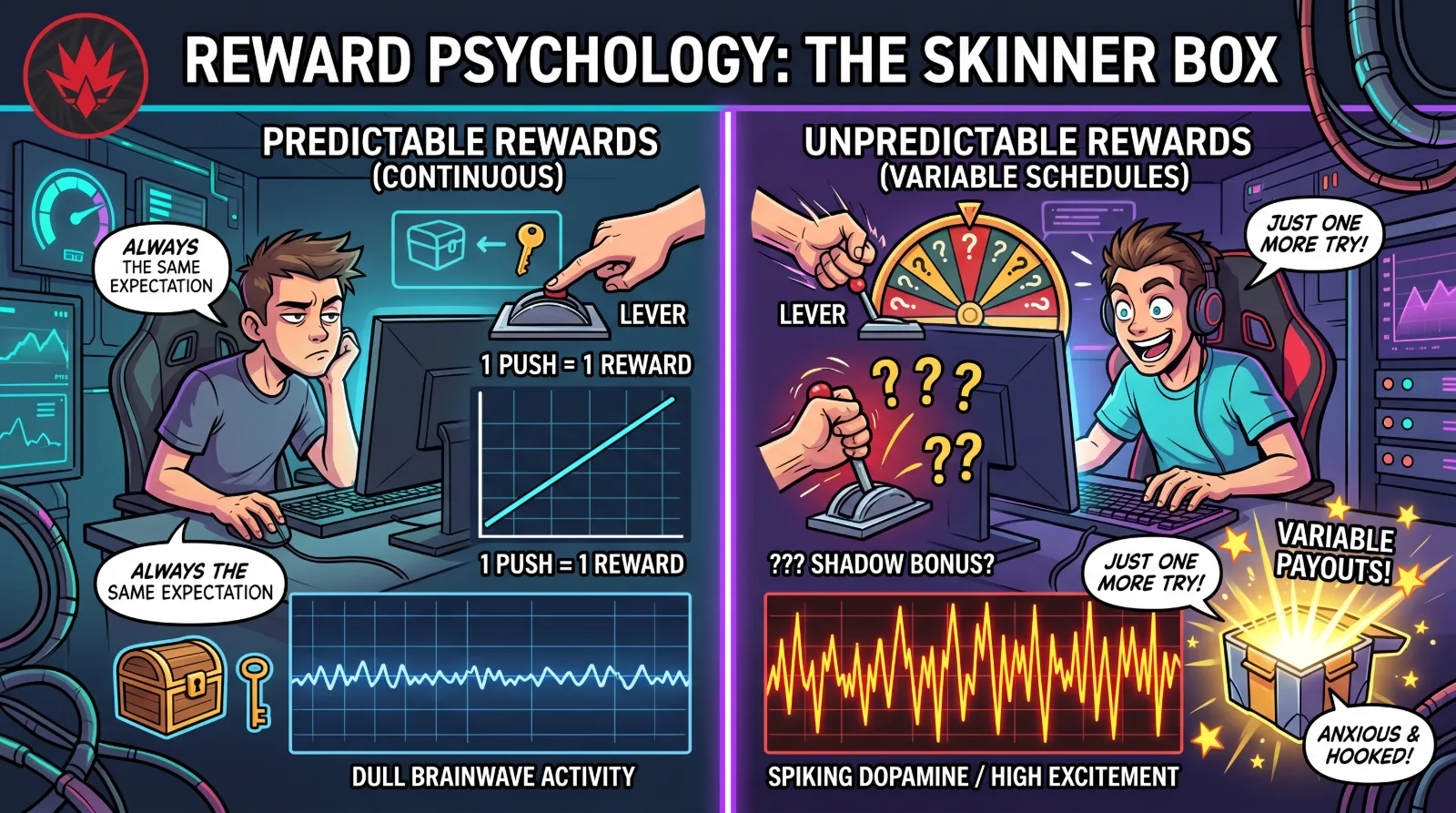
The psychological engine behind modern game monetization originates in the behavioral experiments of psychologist B.F. Skinner:
Operant Conditioning Schedules in Gaming:
Fixed Ratio: [Complete 10 Daily Quests] ------------------------> [Guaranteed 100 Gold Coins]
Variable Ratio: [Open Mystery Supply Crate] ---> [??? (0.5% Jackpot OR 99.5% Common Trash)]
- Fixed Schedules (Low Compulsion): When a player knows that completing exactly five matches yields one cosmetic hat, the behavior is rational and task-oriented. Engagement drops the moment the milestone is achieved.
- Variable Ratio Schedules (High Compulsion): When rewards are dispensed unpredictably, dopamine response spikes dramatically. The human brain equates the uncertainty of the outcome with heightened anticipation, driving prolonged engagement cycles.
Audiovisual Manipulation: Amplifying the "Near-Miss"
Opening a digital reward container is carefully staged:
- The Audio Crescendo: Rising orchestral chords and rhythmic clicking sounds build auditory suspense as the digital reel decelerates.
- Visual Near-Misses: Algorithms intentionally display ultra-rare legendary items directly adjacent to the common item awarded, triggering a cognitive "near-miss" reaction that encourages immediate re-engagement.
- Sensory Validation: Explosive particle effects, golden screen flares, and triumphant horn fanfares trigger regardless of the item's actual utility, cementing a positive psychological loop.
The Regulatory Pivot: Why Battle Passes Took Over
As international gaming commissions enacted transparency mandates requiring public disclosure of drop rates, publishers pivoted from random containers to Battle Passes:
- Predictable Value Exchange: Players purchase access to a transparent progression track where every unlock is visible in advance.
- Sunk Cost Architecture: By tying unlocks to player time investment, games leverage the fear of missing out (FOMO). If a player buys an entry pass, they feel psychologically compelled to log in daily before the seasonal timer expires, generating record daily active user (DAU) retention metrics.
- The Crossover: Understanding the mathematical and behavioral mechanics that underpin modern digital reward systems and gaming entertainment reveals how contemporary entertainment harmonizes risk, reward, and psychological pacing.