How to Read Hidden MMR, KAST & Headshot Stats
Wondering why your Rank Rating gains feel completely stalled? Here is how to use Valorant tracker apps to analyze hidden Matchmaking Rating (MMR), calculate true impact via KAST %, and fix stat plateaus.

Decoding Your Rank: The Real Mechanics Behind Valorant Tracker Stats
Every ranked player has experienced the frustration: you put together a three-game win streak, only to earn +16 RR per win, followed by a single loss that wipes out -24 RR. Blaming the matchmaking system is common, but third-party match trackers reveal the underlying mathematical explanation: your Hidden Matchmaking Rating (MMR) has decoupled from your visible rank.
Relying solely on your in-game career tab gives an incomplete picture of your performance. Raw Kill/Death ratios reward low-impact exit frags and punish supportive utility. To systematically identify leaks in your gunplay, you must analyze secondary performance metrics.
Below is the definitive breakdown of how tracker overlays operate, how Riot’s hidden MMR engine evaluates individual skill, and which telemetry statistics actually determine your rank progression.
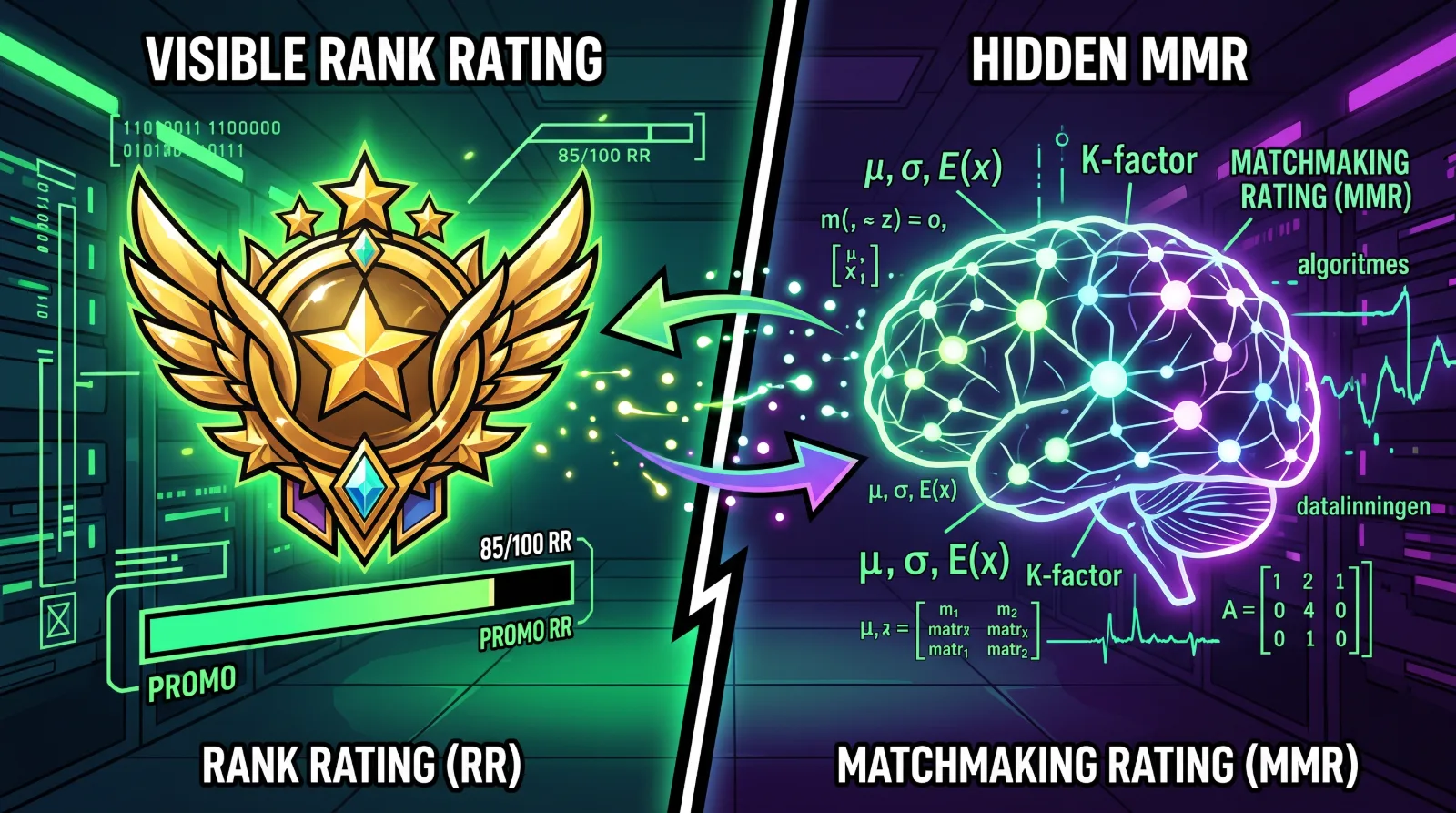
Visible RR vs. Hidden MMR: Why Your Point Gains Stall
Valorant operates two distinct rating systems simultaneously:
| Rating Metric | What It Represents | Can You See It? | How It Behaves |
|---|---|---|---|
| Rank Rating (RR) | Your cosmetic ladder position (e.g., Platinum 2, Ascendant 1) | Yes (In Client) | Moves in increments of roughly 10–30 points per match. |
| Matchmaking Rating (MMR) | Internal mathematical confidence score of true player skill | No (Hidden) | Moves gradually based on round win differentials and encounter MMR. |
The "Rubber-Banding" Effect
If your visible rank climbs faster than your hidden MMR (common during lucky win streaks), the system believes you are placed above your true skill level. To correct this, the algorithm dampens your RR gains (+14 to +16) and increases RR losses (-22 to -25).
To normalize point distribution, you must maintain a positive win rate over 15 to 20 consecutive matches against lobbies seeded higher than your current display tier.
The 3 Critical Stats That Actually Matter (Ignore K/D)
High-elo coaches and scouting platforms evaluate players using three non-cosmetic metrics:
Key Performance Indicators for Ladder Climbing:
[============================= ] KAST % (Target: >72%)
[===================== ] Damage Delta / Round (Target: >+20)
[============= ] First Blood Success % (Target: >55%)
1. KAST % (Kill, Assist, Survived, Traded)
KAST measures the percentage of rounds where you made a tangible contribution.
- Calculation: If you secure a kill, grant an assist, survive the round, or get traded within 3 seconds of dying, that round counts toward your KAST.
- Benchmark: Immortal and Radiant players consistently maintain a KAST above 72%. Even if you post modest frag numbers, a high KAST indicates you are rarely dying in isolated positions without trade potential.
2. Damage Delta per Round (DD/R)
Raw kills can be padded by finishing off enemies who already have 10 HP. Damage Delta calculates total damage dealt minus total damage received per round.
- Positive Delta (+20 to +40): You are regularly softening targets, enabling teammates to secure clean trades.
- Negative Delta (-10 or lower): You are taking heavy damage early in rounds without trading back substantial hitpoints.
3. Headshot Percentage (HS %) Context
While a 30%+ headshot rate looks impressive on tracker profiles, context dictates value:
- Phantom Users: Naturally average 20%–26% due to bullet spray dynamics.
- Vandal Users: Should target 25%–35%. Anything lower indicates you are relying on panic crouching and body sprays rather than clean crosshair placement. (Check out our best Valorant crosshair codes guide to tighten reticle alignment)[cite: 15].
Is Running Tracker Overlays Safe from Vanguard Bans?
The short answer is yes, provided you use verified API partners.
Legitimate trackers (such as Tracker Network / TRN and Blitz) interact with Riot Games via official, authenticated API developer tokens. They do not inject code directly into the active VALORANT.exe process or hook into game memory:
- Overwolf / Client Apps: Read live lobby data only through approved public endpoints.
- Zero Vanguard Violations: Verified tracking software does not trigger third-party anti-cheat sanctions.
- Warning: Never download unverified executable files claiming to reveal enemy ranks in private lobbies or inject custom in-game radar overlays, as memory manipulation triggers permanent hardware ID (HWID) bans.
3 Common Mistakes When Analyzing Tracker Profiles
- Obsessing Over In-Game Leaderboards: Chasing the match MVP title often encourages baiting teammates. If you bait your initiator to get two late kills while losing the round, your K/D improves, but your hidden MMR suffers from round-differential loss penalties.
- Ignoring Map-Specific Win Rates: Most players have a 60% win rate on two maps and sub-40% on others. Analyzing map-specific win rates allows you to identify structural agent selection flaws on difficult layouts like Breeze or Sunset.
- Tracking Too Few Matches: Evaluating performance based on a 5-game sample introduces heavy variance. Only draw conclusions on agent pool adjustments after logging at least 25 ranked matches in a specific role.