Skill vs. Luck in Esports: How Data Analytics Predicts Pro Tournament Outcomes
Why do heavy favorites lose best-of-one matches while dominating best-of-five series? Here is how professional analysts and predictive algorithms calculate map pool variance, pistol round volatility, and true win probability in competitive gaming.

The Variance Equation: Deconstructing Skill vs. Luck in Modern Esports
In traditional sports like soccer or basketball, physical endurance, spatial tactics, and execution dominate. In competitive gaming, tactical mastery must coexist with internal algorithmic systems, random map generation, and micro-second network latency.
For competitive analysts, bookmakers, and tournament coaches, separating repeatable mechanical skill from short-term statistical variance is the holy grail of predictive modeling. A single lucky bullet spray through a smoke grenade can trigger an economic collapse in Counter-Strike 2, just as an unexpected elemental dragon spawn can flip a League of Legends World Championship final.
Below is an exploration of how modern predictive models evaluate true team skill, why tournament match formats dictate underdog upset odds, and how data analytics is transforming competitive sportsbooks.
Format Volatility: The Best-of-One (Bo1) Underdog Trap
The single largest factor introducing "luck" into competitive tournament results is match length:
Upset Probability by Series Length:
[============================= ] Best-of-One (Bo1): 38.4% Historic Upset Rate
[=============== ] Best-of-Three (Bo3): 18.2% Historic Upset Rate
[======= ] Best-of-Five (Bo5): 7.1% Historic Upset Rate
- The Best-of-One Anomaly: In tactical shooters, winning both pistol rounds grants a team roughly 4 to 6 rounds of structural economic advantage due to bonus momentum. In a short 13-round regulation match (MR12), winning both pistol rounds accounts for nearly 40% of the rounds required to win the entire map. An underdog only needs a few high-variance rounds to steal the series.
- The Best-of-Three/Five Normalization: Over extended series, variance flattens. Elite squads hold deeper map pools, superior defensive communication, and mid-series adaptation playbooks that systematically expose one-dimensional strategies.
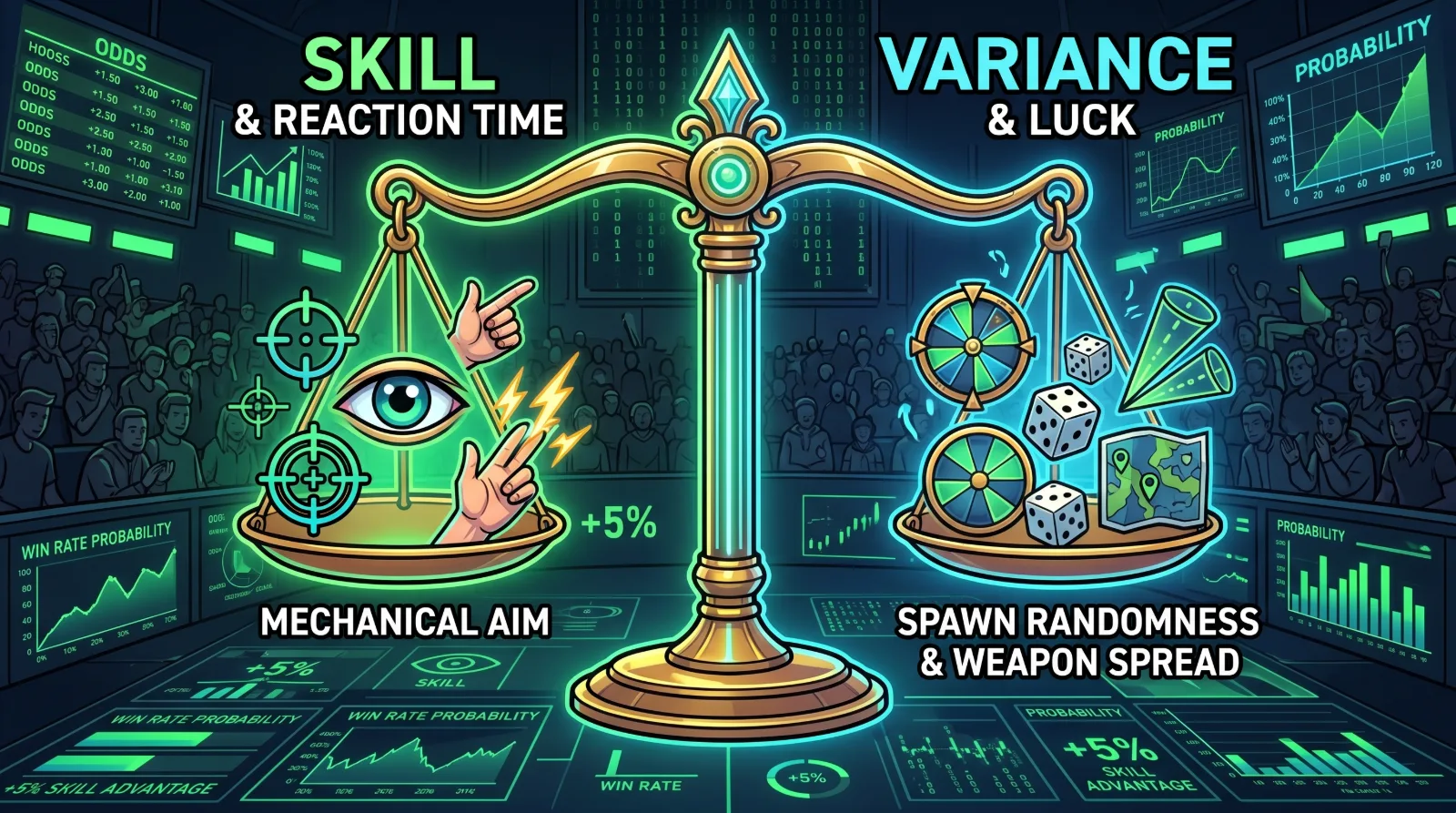
Quantifying the "Uncontrollable": RNG Levers in Pro Games
Even in hardcore competitive titles, developers intentionally introduce micro-variance:
- CS2 First-Bullet Inaccuracy: Weapons do not possess 100% pinpoint accuracy at extreme distances. An AK-47 aiming dead-center at an enemy’s head at 50 meters has roughly an 8% chance to miss due to hardcoded cone spread.
- League of Legends Dragon Buffs: The sequence of elemental drakes (Infernal, Cloud, Mountain, Hextech) spawns semi-randomly. A team composition optimized for early burst damage benefits dramatically more from an Infernal Drake soul than a defensive team that prefers Mountain resistance buffs.
- Spawn Position Advantage: In battle royales like Apex Legends or Fortnite, zone pull rotations can award an unmoving team fortified positional high ground while forcing competitors to rotate through open sniper lanes.
Predictive Analytics: How Modern Odds Engines Model Matchups
Today’s leading esports data platforms and sportsbooks no longer rely on simple win/loss streaks to set competitive lines. They evaluate live API feeds using advanced metrics:[cite: 18]
- Round-Adjusted Rating: Evaluating player damage exclusively in high-leverage rounds (e.g., clutches and buy rounds) rather than stat-padding during anti-eco rounds.
- Map Pool Veto Differential: Modeling team historical win rates on individual map layouts, specifically weighting offensive vs. defensive half-side execution records.
- Economic Recovery Efficiency: Measuring a team's mathematical probability of winning a round immediately following a broken buy cycle.