The Science of Chance: How RNG Works in Video Games vs. Licensed Gaming
Ever wondered why that 1% drop rate feels impossible or how games calculate critical hits? Here is the complete breakdown of Pseudo-Random Number Generation (PRNG), pity counters, and Provably Fair cryptographic seeds.
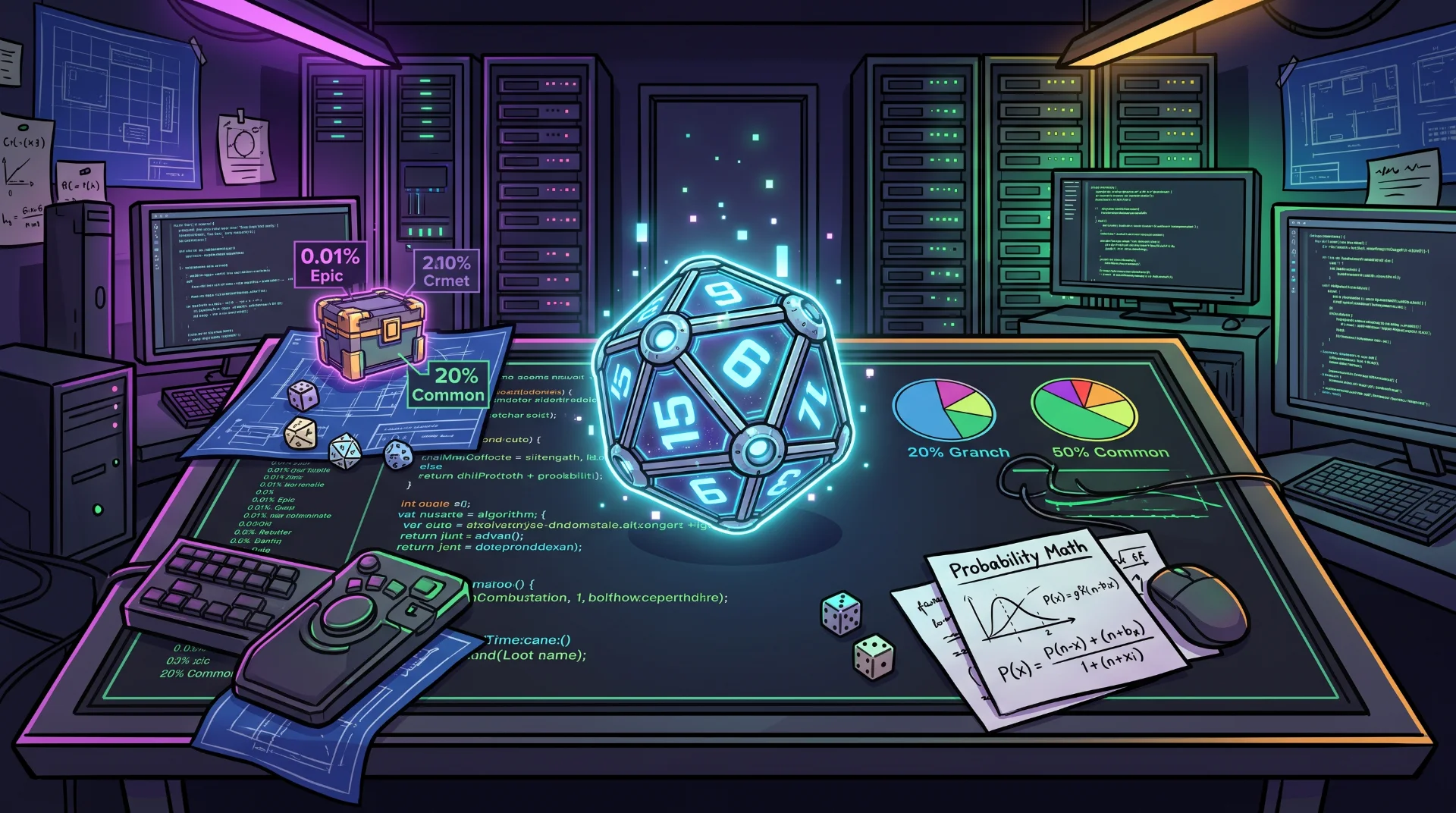
The Architecture of Uncertainty: How Random Number Generation Dictates Modern Games
Whether you are rolling for a 5-star character in a gacha RPG, hunting a 0.03% knife unboxing in a tactical shooter, or landing a critical strike in an arena combat match, your gameplay experience is governed by three letters: RNG (Random Number Generation).
To the average player, randomness feels like pure luck. To a game designer or software engineer, randomness is a meticulously balanced mathematical pipeline. Understanding the difference between raw chance, algorithmic manipulation, and legal fairness certifications reveals how modern games maintain player engagement without breaking mathematical balance.
Below is the definitive breakdown of how digital randomness is programmed, why pure randomness feels terrible to human psychology, and how certified gaming systems verify mathematical integrity.
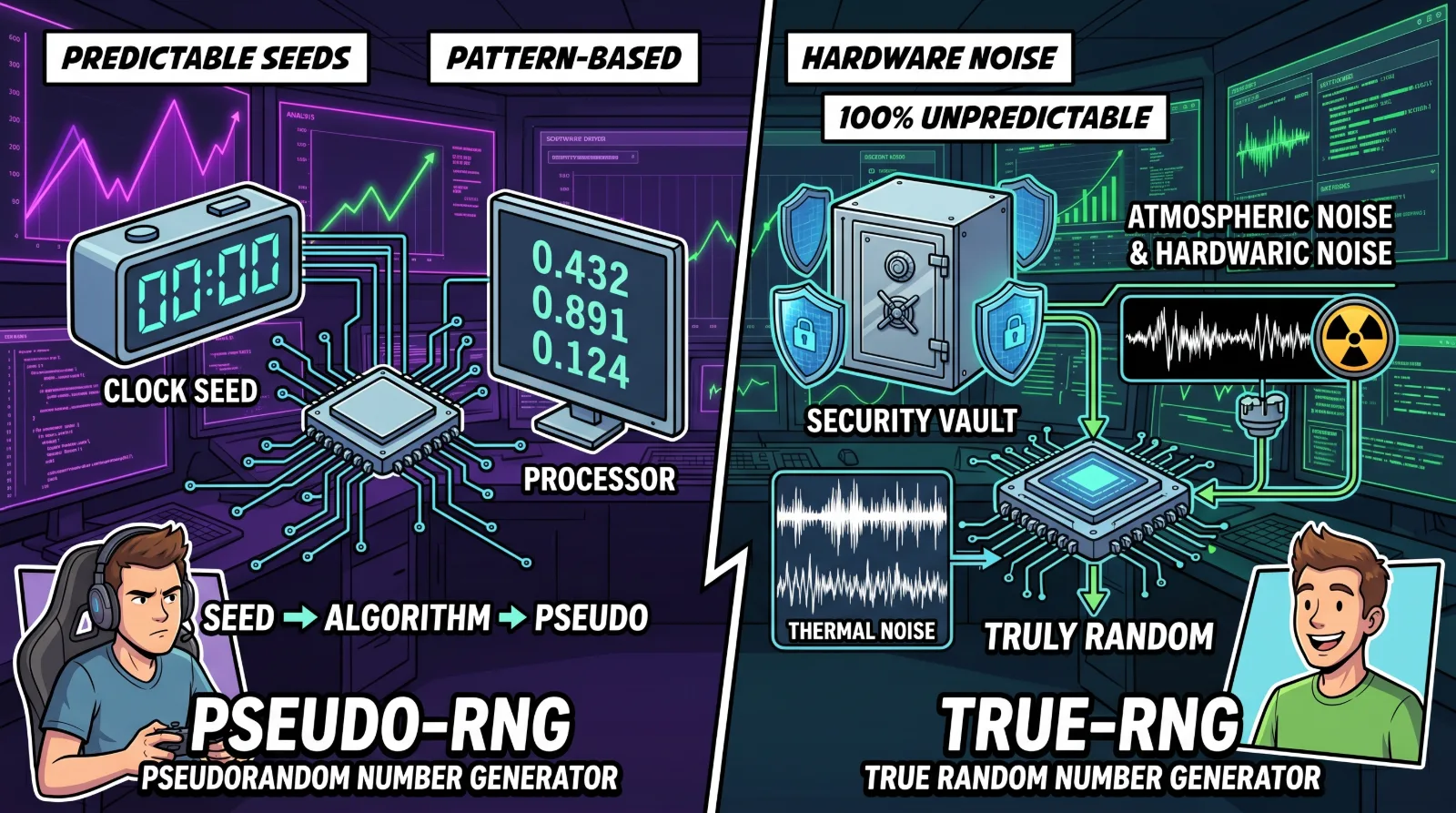
Pseudo-RNG vs. True-RNG: Why Computers Cannot Roll Real Dice
Computers are deterministic logic engines: given the exact same input, they produce the exact same output. Generating genuine, unassisted randomness is mathematically impossible using pure software code.
Deterministic Algorithm Flow:
[Time Seed / Hardware State] ---> [Mathematical PRNG Function] ---> [Uniform Random Distribution (0.0 to 1.0)]
- Pseudo-Random Number Generators (PRNG): Video games utilize algorithms (such as the Mersenne Twister) that take an initial input called a seed (often the precise millisecond on the system clock) and calculate a sequence of numbers that mimics randomness.
- True Random Number Generators (TRNG): Used in security cryptography and certified gaming. TRNG extracts randomness from unpredictable physical environmental noise—such as thermal diode fluctuations or radioactive atmospheric decay—ensuring that the next outcome cannot be mathematically predicted even with full access to the source code.
The Human Psychology Trap: Why Games "Rig" Randomness for Fun
If a game gave a shotgun an authentic 25% chance to miss point-blank, players would miss four shots in a row roughly 0.4% of the time. While statistically normal, human players perceive this as an unfair bug.
To maintain satisfying gameplay, video games employ Pseudo-Random Distribution (PRD):
- The Escalating Odds Engine: Every time your attack fails to land a critical strike, the game quietly increases your hidden critical chance on the next hit. Once a critical strike procs, the probability resets to a low baseline.
- The "Pity" System: Popularized by gacha games and mobile titles, pity timers guarantee that if a player rolls 80 times without receiving a top-tier asset, the 81st roll forces a 100% success rate, flattening variance and mitigating player churn.
Fairness Compliance: Cryptographic RNG in Licensed Gaming
While video game studios are free to adjust drop tables behind the scenes to maximize playtime, certified digital entertainment operates under strict mathematical mandates:
| Metric | Video Game Loot Drops | Certified Gaming & Casino RNG |
|---|---|---|
| Probability Code | Dynamic (Adjustable based on player retention). | Strictly Immutable (Locked and compiled). |
| External Auditing | None (Proprietary publisher secrets). | Mandatory third-party testing (eCOGRA, iTech Labs, GLI). |
| Return to Player (RTP) | Zero real-world cash return guarantee. | Legally mandated mathematical return averages (e.g., 95%–98%). |
| Provably Fair Tech | Rarely implemented. | Cryptographic client-server seed hashes verifiable on-chain.
Under modern Provably Fair cryptographic protocols, players can verify that the outcome of a round was generated using a pre-committed cryptographic hash that the operator could not manipulate mid-game, setting a gold standard for transparent mathematical entertainment.